My Blog List

Saturday, October 22, 2011

FLANDERS FIELDS FRANCE


When I was growing up in the small village of Nelsonville, Ohio, I remember being given a crepe-paper  poppy to wear for Memorial Day.  My dad went to a lot of activities at the local VFW (Veterans of Foreign Wars) and he probably brought them home.  I do have a vague remembrance of my mom getting some from a lady on the Village Square while shopping.  I have since learned that poppies were distributed around "Poppy Day", which was usually the same as Memorial Day in May.  I am not sure if this tradition continues today, I don’t recall seeing poppies any other time since my youth.

Poppies in the fields of Vignes, France

When we traveled recently to Northern France and Southern Belgium I was surprised to find myself in the area known as Flanders.  As we drove about along the back roads we found the “Flanders’ Poppies” growing along the edges of the roads. 
The use of the poppy was inspired by the World War I poem In Flanders Fields. Its opening lines refer to the many poppies that were the first flowers to grow in the churned-up earth of soldiers' graves in FlandersCanadian physician and Lieutenant Colonel John McCrae is popularly believed to have written it on 3 May 1915 after witnessing the death of his friend (a fellow soldier) the day before. 
The poem was first published on 8 December 1915 in the London-based magazine Punch

In Flanders Fields  written by Lieutenant Colonel John McCrae
In Flanders fields the poppies blow
      Between the crosses, row on row,
   That mark our place; and in the sky
   The larks, still bravely singing, fly
Scarce heard amid the guns below.

We are the Dead. Short days ago
We lived, felt dawn, saw sunset glow,
   Loved and were loved, and now we lie,
         In Flanders fields.

Take up our quarrel with the foe:
To you from failing hands we throw
   The torch; be yours to hold it high.
   If ye break faith with us who die
We shall not sleep, though poppies grow
         In Flanders fields.
Poppies in a field near Fromelles, France


In 1918, American YWCA worker Moina Michael, inspired by the poem, published a poem of her own called We Shall Keep the Faith.[2] In tribute to McCrae's poem, she vowed to always wear a red poppy as a symbol of remembrance for those who served in the war.[1] At a November 1918 YWCA Overseas War Secretaries' conference, she appeared with a silk poppy pinned to her coat and distributed 25 more to those attending.[1] She then campaigned to have the poppy adopted as a national symbol of remembrance.

"We Shall Keep the Faith"  written by Moina Michael
Oh! you who sleep in Flanders Fields,
Sleep sweet - to rise anew!
We caught the torch you threw
And holding high, we keep the Faith
With All who died.
We cherish, too, the poppy red
That grows on fields where valor led;
It seems to signal to the skies
That blood of heroes never dies,
But lends a lustre to the red
Of the flower that blooms above the dead
In Flanders Fields.
And now the Torch and Poppy Red
We wear in honor of our dead.
Fear not that ye have died for naught;
We'll teach the lesson that ye wrought
In Flanders Fields.
In Flanders Fields we fought
If you like our posts please SOMEBODY send us a comment.  We would love to know what you think of our postings.

Tuesday, October 11, 2011

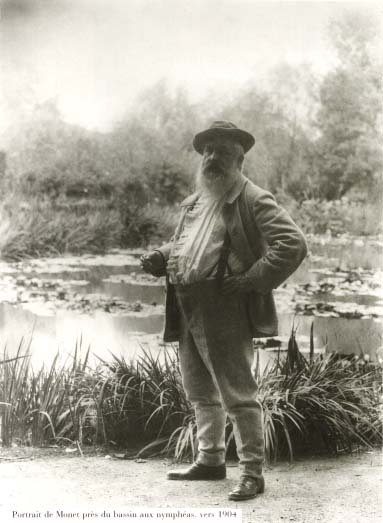
Claude Monet - Giverny, France

Claude Monet

We drove 4 hours just to see these beautiful gardens.


When Claude Monet and his family settled in Giverny, France in 1883, the land on the property consisted of an orchard that sloped gently down toward the road and was enclosed by high stone walls. 


Bill brought a piece home with him in his suitcase.


Those stone walls are still standing and have large chunks of flint embedded in the mortar.


Claude Monet did not like organized nor constrained gardens. He married flowers according to their colors and left them to grow rather freely.  Monet made a garden full of perspectives, symmetries and colors.   


Today the land is divided into flowerbeds where flower clumps of different heights create volume. Fruit trees or ornamental trees dominate the climbing roses, the long -stemmed hollyhocks and the colored banks of annuals. 
Monet mixed the simplest flowers (daisies and poppies) with the rarest varieties. 


Espalier Apple Trees


Apple trees only three feet tall are espaliered along the edge of the gardens while climbing roses arch high overhead.


In 1893, ten years after his arrival at Giverny, Monet bought the piece of land neighboring his property on the other side of the railway. 
It was crossed by a small brook, the Ru, which is a diversion of the Epte, a tributary of the Seine River. With the support of the prefecture, Monet had the first small pond dug; even though his peasant neighbors were opposed. They were afraid that his strange plants would poison the water. 
Michelle, taking pictures for her flower series.


Later on the pond would be enlarged to its present day size. The water garden is full of asymmetries and curves. It is inspired by the Japanese gardens that Monet knew from the prints he collected avidly.  


In this water garden you will find the famous Japanese bridge covered with wisterias, other smaller bridges, weeping willows, a bamboo wood and above all the famous nympheas which bloom all summer long. The pond and the surrounding vegetation form an enclosure separated from the surrounding countryside.


Never before had a painter so shaped his subjects in nature before painting them. And so he created his works twice. Monet would find his inspiration in this water garden for more than twenty years.


After the Japanese bridge series, he would devote himself to the giant decorations of the Orangery. 


Always looking for mist and transparencies, Monet would dedicate himself less to flowers than to reflections in water, a kind of inverted world transfigured by the liquid element.


After Claude Monet's death in 1926, his son Michel inherited the house and garden of Giverny. He did not live there and it was Monet's step-daughter Blanche who took care of the property. Unfortunately after the Second World War the house and garden were neglected. In 1966 Michel Monet made the Academie des Beaux-Arts his heir.


Almost ten years were necessary to restore the garden and the house to their former magnificence. Not much was left. The greenhouse panes and the windows in the house were reduced to shards after the bombings. Floors and ceiling beams had rotted away,  a staircase had collapsed. Three trees were even growing in the big studio.  The pond had to be dug again. Then the same flower species as those discovered by Monet in his time were planted.


Monet didn't like dark wood so he painted his dining room in yellow.

Thanks to generous donors, mostly from the USA , the house was given a facelift. The ancient furniture and the Japanese prints were restored.  Today 500 000 visitors discover Monet's gardens each year during the seven months that it is open.


Wednesday, October 5, 2011

Travels in Ghent, Belgium

Written by Bill Blimes:
Toward the end of our first week in Europe our hosts, Christophe and Houria Selosse, invited us to go to Ghent, Brussels with them.  We had been visiting places around Sailly sur la Lys and Lille but hadn’t yet gone too far afield.  We were excited and happy to have them take us on our first big trip. 
The history of Ghent began in 630 when St. Amandus chose the site to construct an Abby because it was located between two rivers, the Lys and the Sceidt.  Ghent is located in the Flemish region of Belgium and is the capital and largest city of the East Flanders province.  Until the 13th century, Ghent was the biggest city in Europe after Paris; it was bigger than London, Cologne and Moscow.  
The center of Ghent is a “no traffic zone” meaning that no motor vehicles are allowed.  This means you park where you can and then hike into the town center.  Many of the streets are cobblestone which can be a little treacherous to walk upon.  We found a free parking spot along a street and then began our trek.  If I had realized how far it was and what shape I was going to be in by the time we were done at the end of the day, I would have offered to pay to park in a car park near the town center.  But I didn’t and so off we went on our big adventure.  

As we got into the center of town, we found huge crowds which seemed to grow larger as the day went on.  We learned that Ghent’s annual cultural festival, was in full swing.  Every year this long-established, ten-day cultural event takes over Ghent’s historic city centre. There is free music on all the central squares and hundreds of other activities, plus three international-level festivals.  I read somewhere that it is “one of the craziest festivals in Europe."

We walked around through a market along one of the canals.


We visited a couple of churches, and then made our way to a small restaurant where we sat in a corner near the front door and enjoyed typical Ghent food.  We got to talking to the people at the table next to us and found out they were from New Orleans.  They were part of a crew shooting a movie in Brussels and as they had the day off they had come to Ghent to see the sights.  It was nice to run into some Americans.  

 After lunch we got in line to ride a canal boat through the city.  Because of the many canals twisting through the city you get a whole different view of the sights and you get to see them sitting down.  We had an excellent tour guide and as our boat had tourists from Belgium, Spain, England and America he repeated everything three times in three different languages.  It was all rather interesting.   


We went under an old bridge that was built in the thirteenth century.   (Yes, we ducked.)


We passed a line of buildings that were sitting next to each other but each from a different time period reflected in their architectural style.   


We passed houses that had docks right on the canal that were like a porch on their home.   


We went by the Gravensteen, or "Castle of the Count" in Dutch, which dates back to the Middle Ages. The present castle was built in 1180 by Count Philip of Alsace and was modeled after the crusaders' castles the count encountered when he participated in the second crusade.   


 We also saw the 91-meter-high Belfry of Gent that overlooks the old city center. Over the centuries, it has served not only as a bell tower to announce the time and various warnings, but also as a fortified watchtower and town treasury. Construction of the tower began in 1313, 


We passed by the oldest house in Ghent.  It is built of wood.  Early Ghent, even the city walls, at one time were all built of wood. 


At last our day in Ghent ended.  We began to make our way back to the car and I think Houria could tell I was done in.  She suggested we all wait at the edge of the square and Christophe would go and get the car.  I was so relieved.  I don’t think I could have made it back to the car.  I ached in every bone in my body.  With the company of such kind hosts it was a memorable trip - even though we didn’t get wet!

Thursday, September 22, 2011

Sculptures and Garden (Sculptures et Jardin)


Sculptures et Jardin
One sunny day this summer we decided to visit some gardens in the Nord-Pas de Calais, a northern region of France.  We located a brochure we had picked up at a tourist informaton center somewhere in our travels and decided to visit the Sculptures et Jardin in the village of Bergueneuse.  We entered the address in our trusty GPS and we took off on another adventure.  We traveled about an hour though the French countryside and soon came to Bergueneuse, a village of about 200 inhabitants.   


After driving around a little we found the gate into the garden but it said they were closed for lunch from 12:00 until 2:00pm.  Of course, it was noon when we arrived so we drove on past and came to a dead-end road.   
Along this dead-end road were some houses with beautiful flower beds and boxes.   


We took photos of them and then drove back to the garden.   We decided to ring the bell and pretend we had not read the sign since it was in French.   

Sylvia pulled the rope on the bell and an elderly man, holding onto a young boarder collie, came and opened the gate and made us welcome in his halting English. It turned out the gardens were the beautiful yard around his home.   


He made us understand that he was the sculptor and his wife was the gardener.  She then joined him and with many smiles, and no English, invited us to walk around the garden.  The gardens are located around Monsier et Madame Droulez’s home, a typical cottage dating from the late eighteenth century.  


 Among the trees, shrubs and flower beds stuck in places are funny characters of steel straight out of the imagination of the artist owner. The planting beds are laid out in such a way as to create rooms or spaces that flow one into another as you circle about through the yard. The plants included many familiar ones; roses, peonies, garden phlox, etc. and others that were not so familiar.  


 As we walked about taking photos and looking at all the sights we were joined by Madame Droulez and she began pointing out some of the rarities in her garden.  


 She spoke very little English but we were able to converse through the Latin or botanical names of many of the plants.  While we may not have been familiar with some of the varieties, we did recognize the family names of many.   


She also pointed out a trellis that was made from an elevator (she called it a lift) door from an old hotel in Paris.  She was also very proud of her planters of many kinds of small succulents and ground covers. After spending an enjoyable couple of hours with this lovely couple in their garden we said our goodbyes and went on to our next adventure…

Thursday, September 15, 2011

Mont Saint Michel, France

 Writing by Bill & Pictures by Sylvia
After visiting the impressive American Cemetery at the Normandy Beaches we continued to travel south to Mont Saint Michel.  This abbey is one of France’s most iconic attractions and a UNESCO World Heritage Site visited by more than 3 million people every year. It is famously located on a rocky tidal island (meaning it’s an island only at high tide; however, it is always connected via causeway to the mainland) almost a mile off of the coast of lower Normandy.  As we approached the Causeway, we noticed large flocks of sheep grazing on the flat land that lead up to the sea. Dikes (polderisation) and occasional flooding created salt marsh meadows that were found to be ideally suited for grazing sheep.

The well-flavored meat that results from the diet of the sheep in the salt meadows, makes agneau de pré-salé (salt meadow lamb), a local specialty that may be found on the menus of restaurants that depend on income from the many visitors to the mount.


From a distance you can see the protective walls that enclose the island village and abbey.  The abbey dates back to Roman times, and was founded by Aubert, Bishop of Avranches.  It was called Mont Tombe [a sanctuary] that was dedicated to the Archangel Michael, on October 16, in 708.  Officially the name became Mont-Saint-Michel some two hundred years later, when the church was built on top of this granite out-cropping by Benedictine Monks.  

The Romanesque abbey of today was not started until the year 1023.  It was built primarily as in those times for the church to enforce its authority during the crusades.  According to legend, the Archangel Michael appeared to St. Aubert, bishop of Avranches, in 708 and instructed him to build a church on the rocky islet. Aubert repeatedly ignored the angel's instruction, until Michael burned a hole in the bishop's skull with his finger.  Ouch!
With the celebration of the monastic's 1000th anniversary, in the year 1966 a religious community moved back to what used to be the abbatial dwellings, perpetuating prayer and welcoming the original vocation of this place. Friars and sisters from "Les Fraternités Monastiques de Jerusalem" have been ensuring a spiritual presence since the year 2001.

We arrived in the late afternoon.  We had learned that it was best to arrive early in the morning or late in the afternoon to avoid the biggest crowds.  We had also read that we needed to be careful where we parked as some of the lower parking lots were flooded at high tide.  The first lot we pulled into was at least a half mile from the island and we asked if we could find a safe place closer and the lot attendant directed us to another drive that took us much closer and we were able to find a parking spot along the main drive above the parking lots.  This proved to be a wise move because when we returned to the car later in the evening, the parking lots below us were partially flooded by the incoming tide. The tides are some of the most dangerous in the world.  This seemingly tranquil, quiet abbey stands so proud on the summit in rather calm looking tidal pools, yet the tides are fierce and have killed many people over the centuries.  The tides come in swiftly, changing between low and high tides up to 60 feet, and with a force of over 3 feet per second. These are the highest tides in continental Europe.  The tides in the area change quickly, and have been described by Victor Hugo as "à la vitesse d'un cheval au galop" or "as swiftly as a galloping horse".  We had a chance to view this fact up close and personal.  After parking we walked across a vast paved area that was down lower than where we had parked. 

We paused here to have our picture taken and went on to the entrance to the island. After finding the tourist office and paying our fees we made our way through the outer gate into the very narrow street that wound upward through the village. It was at this point we realized the guide books were correct about the crowds leaving in the late afternoon.  We felt like we must be going the wrong way as most people were making their way to the gate to leave.
In the village that wraps around Mont Saint-Michel are touristy shops, restaurants and even a few hotels.   At the same time as the abbey was developing a village grew up during the Middle Ages. It flourished on the south-east side of the rock surrounded by walls dated, for the most part, from the Hundred Years war. This village has always been a commercial entity to serve the needs of the monks that inhabited the monastery and also the pilgrims that came to visit.  Today the village continues to provide services to the many visitors that come every day.
With a permanent population of only 50 or so people, when the masses depart you are presented with an ideal opportunity to experience the atmosphere of what it is like to live here. Early in the morning or late at night the silence is broken only by the subdued and eerie chanting of the monks as they attend their religious rituals.

We began climbing up and up sometimes on streets and other times on steps.  It had begun to drizzle, as it had most of the places that we visited on this trip, and the cobblestones and stone steps became a little slippery.  We made our way up to a chapel and took refuge from the rain for a while and just sat and looked at the people and the beauty of the church.  Eventually we made our way out a small side door and continued our climb upwards.  Everywhere we looked were little hidden gems; a graveyard, a secluded garden, a tower and on and on we up climbed. 

I really had never thought I would be able to climb to the top. In fact, when we first saw Mont Saint Michel from a distance I made the comment that I hoped no one expected me to climb to the top.  But I made it - with many rests along the way up and back.

As we started back down on the other side we noticed the tide had turned and it was fascinating to watch as it rapidly came in around the base of the island, burying mudflats and rocks very quickly.  We took our time and finally made it back to the gate.  Imagine our surprise to find that the large paved area we had walked across to enter the village was not under a swirling mass of muddy water.  Now we saw why they had a raised board walk that went across to where the causeway ended near where we were parked. We sat and rested for a while and watched the faces of the people as we rested.  It was comical to see the reaction when they saw how the water had risen around the entrance to the village.  Eventually, we made our way across the boardwalk and found our car.  We noticed that several cars were still in the lower parking lots and water was beginning to lap around their tires.  As we sat in the car waiting for Michelle and Summer to join us, we saw the tide turn and, almost quicker than one would believe, the waters rushed the other way and the large paved area once again became dry land.  What a phenomenon!